Oyetola Explains How FG Plans to Correct Cargo Imbalance Between Lagos and Eastern Ports
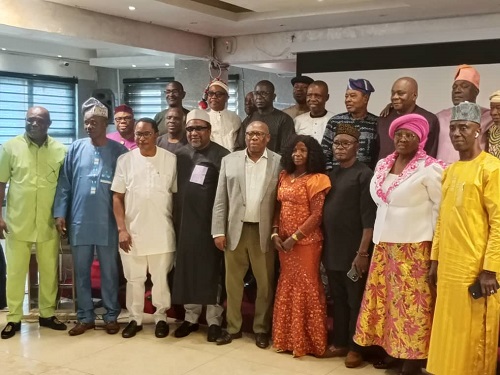
Some participants and League members

• Rehabilitation of Eastern ports are integral parts of Govt’s port devt strategy
By Francis Ugwoke
The Federal Government on Thursday said that the imbalance between Lagos and the Eastern ports is the product of decades of infrastructure, investment, operational and historical factors, but assured that this is being corrected.
Minister of Marine and Blue Economy, Dr. Adegboyega Oyetola while noting that the imbalance cannot be corrected overnight, however affirmed that “it can be corrected and must be corrected”
In a keynote address presented on the occasion of the seminar organised by the League of Maritime Editors in Lagos, titled “Lagos/Eastern Ports: How to Reverse Existing Imbalance in Disproportionate Cargo Vessel Calls”, Oyetola gave details of how the imbalance is being corrected.
The Minister disclosed that the federal government approach is “one of deliberate policy, strategic sequencing, infrastructure investment, private-sector participation, digital transformation, improved security and stronger multimodal connectivity”. I
He said, “ In this regard, the modernisation of the Eastern ports is not being conceived as an isolated regional intervention. It is part of a broader national strategy to develop a resilient, competitive and interconnected port system”.
The Minister who was represented by the Director of Press in his Ministry, Mrs Anastasia Ogbonna explained that the commencement and prioritisation of interventions at the Western ports should not be interpreted as a choice between Lagos and the East.
According to him, “It is about building a stronger Nigerian maritime system, one in which Lagos continues to serve as a major maritime gateway, while Onne, Port Harcourt, Warri, Calabar and other viable ports are developed to handle a greater and more diversified share of national and regional trade.
“Our vision is a Nigeria where cargo moves through the gateway that provides the greatest efficiency, reliability and value, irrespective of its geographical location. That is the port system we are working to build. And when we achieve it, the benefits will go far beyond the ports themselves. We will reduce logistics costs, strengthen regional economies, attract investment, create jobs, improve trade competitiveness and reinforce Nigeria’s position as a leading maritime and logistics hub in West Africa”.
Oyetola said the theme of the conference is particularly timely as it “speaks directly to one of the longstanding challenges facing our maritime sector: the heavy concentration of vessel calls and cargo traffic at the Lagos ports, while the Eastern ports remain relatively underutilized”.
He added, “This imbalance affects much more than the ports themselves. It has implications for national logistics costs, regional economic development, efficient use of infrastructure, investment and, ultimately, the competitiveness of Nigeria’s maritime sector.
“For decades, the Lagos ports, particularly Apapa and Tin Can Island Ports, have handled the overwhelming proportion of Nigeria’s seaborne cargo traffic. This is understandable, given their historical importance and the concentration of commercial activities around Lagos. However, the pressure this has placed on the ports and their connecting infrastructure has become increasingly difficult to ignore.
“We are all familiar with the consequences: congestion, longer cargo dwell and vessel turnaround times, increased demurrage and logistics costs, pressure on our road infrastructure, environmental challenges and inefficiencies throughout the supply chain. At the same time, the Eastern ports, including Onne, Port Harcourt, Warri and Calabar, have considerable strategic and economic potential.
“The proximity Eastern ports to major industrial, agricultural, energy and commercial activities in the South-East and South-South as well as the North Central gives them a natural advantage in serving significant portions of Nigeria’s hinterland. They can also support regional industrial clusters, facilitate exports, promote agro-allied value chains and stimulate economic activity across the Eastern and Niger Delta regions. However, this potential has not yet been fully realized..
“Challenges relating to draft limitations, the condition of infrastructure, navigational constraints, security concerns, hinterland connectivity, equipment, operational costs and the predictability of services have, over the years, affected the ability of the Eastern ports to attract regular and competitive vessel calls. The result is an imbalance that is neither good for the national economy nor sustainable in the long term. Reversing this imbalance is therefore not a regional demand; it is a national economic imperative.
“Under the Renewed Hope Agenda of His Excellency, President Bola Ahmed Tinubu, GCFR, the Federal Government has adopted a deliberate and strategic approach to transforming Nigeria’s maritime infrastructure and positioning the sector as a stronger driver of economic growth. The Ministry of Marine and Blue Economy along with its Agencies is committed to developing a balanced, efficient and interconnected national port system in which Lagos and the Eastern ports complement one another rather than compete for attention and investment.
“Let me state this clearly: the modernisation and rehabilitation of the Eastern ports are integral parts of the Federal Government’s port development strategy. Our objective is to address the infrastructure and operational constraints that have historically limited the competitiveness of these ports. This includes improving channel depths and navigability, rehabilitating critical port infrastructure, enhancing navigational safety, upgrading cargo-handling facilities, strengthening security and improving the overall operating environment for shipping lines, terminal operators and cargo owners.
“The reconstruction of the breakwaters and channel-management interventions, including works along the Escravos Channel for instance , together with new investments by private terminal operators, are important elements of this broader effort. Government is also encouraging greater private-sector participation in port development because we recognise that the scale of investment required cannot, and should not, be borne by Government alone. Our objective in this regard is straightforward: to make every viable Nigerian port capable of competing for cargo on the basis of efficiency, reliability, cost and quality of service.
“I am aware that some stakeholders have asked why major physical modernisation activities are currently receiving particular attention at the Western ports, especially Apapa and Tin Can Island. This is a fair question, and it deserves a clear answer. The approach is not based on preferential treatment for Lagos. It is based on operational urgency, economic necessity, project readiness and responsible sequencing”.
The Minister further added “Our approach is therefore one of deliberate policy, strategic sequencing, infrastructure investment, private-sector participation, digital transformation, improved security and stronger multimodal connectivity. In this regard, the modernisation of the Eastern ports is not being conceived as an isolated regional intervention. It is part of a broader national strategy to develop a resilient, competitive and interconnected port system.
“The commencement and prioritisation of interventions at the Western ports should therefore not be interpreted as a choice between Lagos and the East. It is about building a stronger Nigerian maritime system, one in which Lagos continues to serve as a major maritime gateway, while Onne, Port Harcourt, Warri, Calabar and other viable ports are developed to handle a greater and more diversified share of national and regional trade.
“Our vision is a Nigeria where cargo moves through the gateway that provides the greatest efficiency, reliability and value, irrespective of its geographical location. That is the port system we are working to build. And when we achieve it, the benefits will go far beyond the ports themselves. We will reduce logistics costs, strengthen regional economies, attract investment, create jobs, improve trade competitiveness and reinforce Nigeria’s position as a leading maritime and logistics hub in West Africa”.
In his opening address, the Chairman of the occasion, Capt Iheanacho Ebubeogu noted that one of the ways of measuring the effect of port reputation and competitiveness is by its rating of economic growth.
According to him, port economic growth refers to the increase in regional or national wealth generated by a seaport’s operations and infrastructure.
“It occurs when a port’s capacity, logistics efficiency, and throughput expand, acting as a “funnel” that drives industrial development and connects local businesses to the global market”, Ebubeogu said.
He identified the key benefits as “massive job creation, Industrial and Business Growth, Revenue Generation, Infrastructure Investment, Lower Consumer Prices, International Trade Access, Industrial and Commercial Hubs”.
Ebubeogu added, “ It is also note worthy that the port bottom-line Success, amongst other factors is centered on the volume of the cargo-market it will attract to itself.
“The cargo-market is categorized into two groups:
1. Captive cargo
2. Contestable cargo
“Captive cargo: the captive cargo of a seaport is the volume of goods and raw materials that natively originate from or are destined for its immediate local and regional area.
“This traffic relies on that specific port because transport cost make using other competing port impractical.
key characteristics of captive cargo are:
– local origin: goods are produced or consumed by nearby industries
– Guaranteed volume: provides a stable baseline of business for the port
– Cost advantage: short transit distances make the port cheaper to use than rivals
“Contestable Cargo: Discretionary freight that can easily move to other competing regional port based on price and or services.
“This contestable cargo is the bone of contention as the Eastern Ports are observed to not have their fair market share of it”.
The President of League, Mrs Remi Itie, in her welcome explained that the seminar was specifically to set an agenda for the government.
“ As journalists, one of our primary responsibilities is to set the agenda for policymakers and other arms of government.
We also have a core responsibility to inform the public of happenings in our country and beyond, as well as help to educate and enlighten the citizens.
“Today’s conference is therefore part of these efforts as journalists to do the needful in the area of agenda setting”.
“We all have a responsibility to make our country great. After all, there was a time when Nigeria was on par with the Asian Tigers in the not too distant past. The good news is that we already have the natural and human resources to reverse the trend””.
About Post Author