Arms/ Other Seizures at Ports: Group Commends Customs for Sustained Vigilance
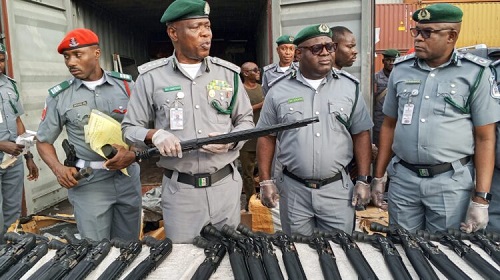
CGC Adeniyi, Compt Anani and other customs officials on Thursday
- It is national security wake-up call, FG must back intelligence customs enforcement – SEREC
By Francis Ugwoke
A freight forwarding group, the Sea Empowerment & Research Center (SEREC), has commended the Comptroller General of Nigeria Customs Service, Dr. Adewale Adeniyi and his management team for vigilance and intelligence that led to the continued seizures of arms and other contrand at the nation’s seaports.
It would be recalled that two suspects were arrested last week over the interception of concealed knock-down parts of pump-action rifles and cannabis-infused products at the Tin Can Island ports.
Before then, the Customs Service had also recorded different seizures of contraband at Apapa port and others.
In a press statement, the Head of Research, SEREC, Fwdr Eugene Nweke, RFF, said the Customs management has sustained vigilance, intelligence-led interventions and remarkable interceptions of prohibited and dangerous consignments across the nation’s ports, land borders and other points of entry.
Nweke said, “SEREC considers these interventions worthy of public commendation, not merely because they represent successful Customs enforcement, but because they increasingly constitute a critical first line of defence in Nigeria’s national-security architecture”.
He opined that the implication of the different seizures is that Nigerian “ports, borders and trade corridors are no longer only economic gateways; they are also strategic national-security frontiers”.
He stated, “A NATIONAL SECURITY WAKE-UP CALL
“SEREC therefore uses this opportunity not only to commend the NCS but to issue a strong wake-up call to the Federal Government and all relevant security and regulatory institutions.
“The recurring interceptions should trigger deeper national-security assessment, intelligence coordination and preventive action.
Nigeria cannot afford to wait until illicit arms, ammunition, narcotics, terrorist logistics and criminal finances have successfully penetrated the country before responding.
The activities and expansionist tendencies of banditry, terrorist and violent extremist organisations and other transnational criminal networks operating within and around the West African sub-region must be proactively contained.
This concern becomes even more compelling as the nation gradually moves towards the 2027 general electioneering period.
Election periods can create additional vulnerabilities through heightened political activity, increased movement of people and goods, illicit financing, proliferation of small arms and light weapons, communal tensions and attempts by criminal elements to exploit political instability.
SEREC therefore urges the Federal Government to intensify intelligence gathering, border surveillance, inter-agency coordination and preventive security measures well ahead of the 2027 electoral cycle, rather than adopting a reactive posture after threats have materialised.
The objective must be clear:
«Nigeria’s ports, borders and critical trade corridors must not become supply channels, logistics platforms or financial conduits for terrorism, banditry, organised crime or election-related violence.»
GOVERNMENT MUST BACK INTELLIGENCE-LED CUSTOMS ENFORCEMENT
SEREC particularly commends the increasing emphasis of the Nigeria Customs Service on intelligence gathering, risk profiling, targeted intervention, information analysis and inter-agency collaboration.
This is the direction modern Customs administration must take.
Contemporary smuggling is no longer principally about individuals carrying contraband across poorly guarded borders. Sophisticated criminal enterprises increasingly employ complex supply chains, false documentation, front companies, concealment techniques, multiple transit routes, trade-based financial mechanisms and legitimate commercial actors to disguise illicit operations.
The response must therefore equally be sophisticated.
SEREC calls for stronger government investment in:
– advanced Customs intelligence and risk-management systems;
– real-time and secure inter-agency information sharing;
– advance cargo and pre-arrival information analysis;
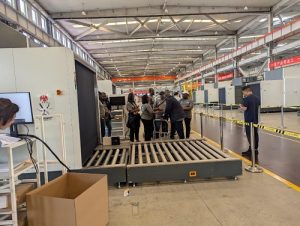
– non-intrusive inspection and detection technologies;
– maritime and land-border surveillance;
– data analytics and intelligence fusion;
– international and regional Customs/security cooperation;
– specialised training for Customs intelligence personnel; and
– improved logistics, welfare and operational support for officers deployed to sensitive locations.
About Post Author